🔮 Weird Tales & Urban Legends
Whispers in the Walls: The Artist's Descent into the Cursed Abandoned Hospital
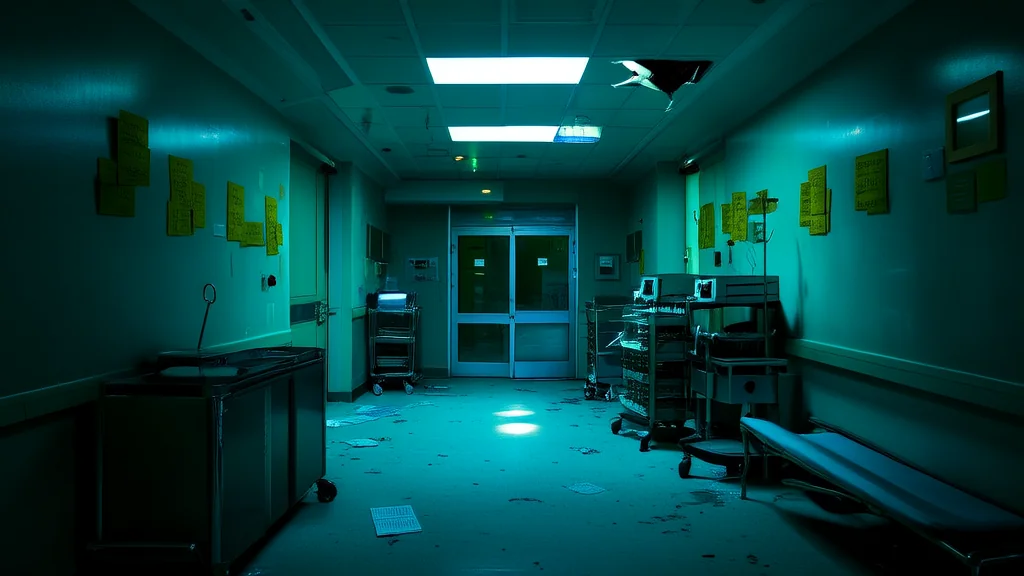
The old hospital had been abandoned for decades, its rusted gates creaking in the wind like a whisper of forgotten memories. Most people avoided it, claiming the place was cursed, but a few curious souls still wandered through its halls, drawn by the stories of patients who never left. Among them was a young woman named Elara, an artist with a fascination for the strange and the unseen.
She arrived at dusk, her flashlight casting long shadows against the cracked walls. The air inside was thick with dust and something else—something that made her skin prickle. The floorboards groaned beneath her feet as she stepped into the main hall, where a chandelier hung crookedly from the ceiling, its crystals dulled by time. A faded sign above the entrance read *St. Marianne’s General Hospital* in peeling letters.
Elara had heard the rumors: that the hospital once housed patients who were not quite human, that some doors led to places that should not exist. She had no idea if any of it was true, but she needed inspiration for her next painting. The hospital’s decayed beauty called to her like a siren’s song.
She wandered through the empty wards, each one more decrepit than the last. In one room, a bed sat untouched, its sheets yellowed and tattered. On the wall, a single handprint was etched into the plaster, as if someone had pressed their palm there in desperation. In another, a mirror reflected only darkness, though when she looked closer, she could see faint shapes moving behind it—figures that vanished the moment she blinked.
As she moved deeper, she found a stairwell leading to the basement. The door was slightly ajar, and the air grew colder as she descended. At the bottom, a corridor stretched before her, lined with doors that all bore the same number: 13. Each door had a small window, and through them, she saw glimpses of what looked like operating rooms, though they were frozen in time. Patients lay on tables, their faces obscured, their bodies covered in white sheets. None of them moved.
Elara felt a pull, as if the hospital itself was guiding her. She opened the first door, and the room was empty except for a single chair in the center. On the chair sat a small child’s doll, its head tilted unnaturally. When she reached out, the doll’s eyes seemed to follow her, and a chill ran down her spine. She backed away quickly, shutting the door behind her.
The next room was different. It was a nursery, with cribs and toys scattered across the floor. But the walls were covered in drawings—childlike sketches of people with too many eyes, or faces that melted into the walls. One drawing showed a girl standing in front of a mirror, her reflection smiling back at her. Elara turned around, but the room was empty. The mirror behind her was fogged, and when she wiped it clean, she saw her own face staring back—but her eyes were black, and she wasn’t smiling.
She ran up the stairs, heart pounding, and emerged into the main hall again. The lights flickered, and for a moment, she thought she heard voices—whispers in a language she didn’t understand. She turned to leave, but the front door was gone, replaced by a solid wall. Panic set in, but she forced herself to stay calm. She retraced her steps, trying to find a way out.
At last, she found a door marked *Exit*. She pushed it open and stepped outside, the night air filling her lungs. The hospital stood behind her, silent and watchful. As she walked away, she glanced back one last time. The windows were dark, but in one of them, she saw a shadow move—just for a second. Then it disappeared.
In the days that followed, Elara tried to forget what she had seen. She painted feverishly, capturing the hospital’s eerie beauty in her work. But no matter how many times she looked at the paintings, something about them unsettled her. The faces in the background seemed to shift, the shadows seemed to breathe. And sometimes, when she closed her eyes, she could hear whispers in the silence, calling her name.
She never returned to the hospital, but she often wondered: was it truly abandoned? Or had it simply chosen its next visitor?
Published on en
🔗
Related Sites
- AI Blog — AI trends and tech news