🔮 Weird Tales & Urban Legends
The Forgotten Mirror in the Attic That Remembered Her Name
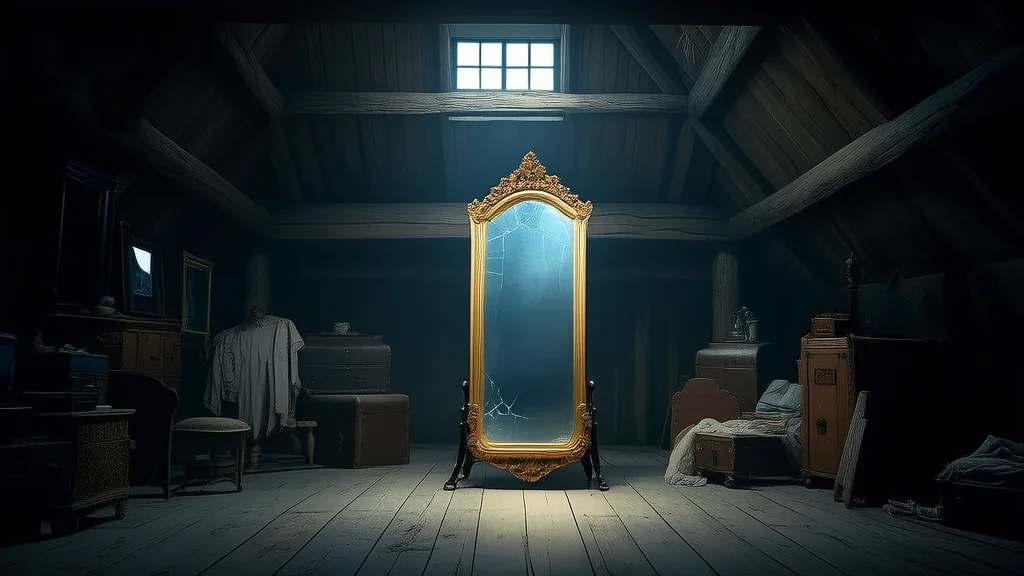
The first time she saw it, the mirror was just a normal antique, dusty and slightly cracked along the edge. It had been in her grandmother’s attic for as long as she could remember, hidden behind a stack of old boxes. Elara hadn’t even known it was there until the night she found herself standing in front of it, staring into its depths with no memory of how she got there.
It was a cold autumn evening, the kind that made the air feel thick with secrets. The attic smelled of mothballs and forgotten things. She had been searching for an old journal when her fingers brushed against the glass. The moment she touched it, a strange warmth spread up her arm, like the sun had suddenly appeared inside her. She stepped back, heart pounding, but the mirror remained still, reflecting only her confused face.
Over the next few days, she kept returning to the attic, drawn by an unexplainable pull. Each time, the mirror seemed different—sometimes darker, sometimes brighter, as if it were breathing. One night, she noticed something odd: her reflection wasn’t moving exactly as she did. Her mouth opened, but the image didn’t speak. Her eyes blinked, but the reflection stayed still. Then, slowly, the reflection raised its hand and pointed at the mirror.
Elara stumbled back, gasping. She turned around, expecting to see someone else, but the room was empty. The only sound was the creak of the old floorboards under her feet. She ran down the stairs, heart racing, but the feeling of being watched never left her.
She began to research mirrors and their history, finding obscure references to "glass doors" and "passages between worlds." Some texts spoke of mirrors that showed not the present, but the past—or the future. Others warned of mirrors that reflected not the person, but another version of them. Elara dismissed most of it as superstition, but the more she read, the more she felt the weight of something unseen pressing against her mind.
One night, she returned to the attic with a flashlight and a notebook. This time, the mirror was clear, and her reflection moved perfectly. But then, without warning, the reflection stopped. It looked directly at her, and smiled. Elara froze. She tried to move, but her body refused. The mirror’s surface rippled like water, and a voice whispered from within.
“Come closer,” it said, not in words, but in thought. The voice was familiar, yet foreign. It was hers, but not quite. She reached out, and the glass became cool beneath her fingertips. A shiver ran through her as she stepped forward, and suddenly, the world around her shifted.
She stood in a version of her own home—but everything was wrong. The furniture was older, the walls darker, and the air smelled of damp wood and something else, something metallic. She turned and saw a door she had never seen before. When she opened it, she found herself in a hallway lined with mirrors, each one showing a different version of herself.
One mirror showed her as a child, laughing with a friend she couldn’t remember. Another showed her wearing a wedding dress, but the man beside her was a stranger. A third showed her standing alone, holding a small box, her face streaked with tears. Each reflection was real, yet impossible.
She tried to leave, but every door led to another mirror. The longer she stayed, the more she felt pulled into the reflections, as if they were trying to take her place. She finally found a mirror that showed her standing in the attic, looking lost. She reached out, and the reflection reached back.
When she opened her eyes, she was back in the attic, breathless, covered in sweat. The mirror was dark, as if it had been waiting. She backed away, heart pounding, and realized something chilling—her hands were shaking, not from fear, but from recognition.
That night, she dreamed of the mirrors again. In the dream, she saw herself walking through a city where the buildings were built upside down, and the sky was a deep purple. She met other versions of herself, each one living a different life. Some were happy, some were sad, some were dead. They all looked at her with the same question in their eyes.
What if this is not the first time we’ve met?
The next morning, Elara found a note on her desk, written in her own handwriting: “They are watching.” She looked around, but no one was there. The mirror in the attic was now completely clear, and when she looked into it, her reflection smiled. Not with joy, but with knowing.
Published on en
🔗
Related Sites
- AI Blog — AI trends and tech news